Venture Portfolio
Research · Fintech · AI · Infrastructure
A founder-led portfolio of operating and development-stage ventures spanning research, guided change, trade finance, blockchain infrastructure, applied AI, energy and financial intelligence.
China is aging. Its workforce is shrinking. Immigration could soften the pressure, as it does in many other aging economies. China has chosen a different route: raise output per worker and replace more routine labour with machines.
The demographic change is already visible. China’s working-age population, defined as people aged 16–59, reached about 922 million in 2012. By 2025 it had fallen to 851 million. In 2025 alone, China recorded 7.92 million births and 11.31 million deaths. People aged 60 and over reached 323 million, or 23 percent of the population.
For much of the reform era, China’s factories could draw on a large flow of young rural workers. That flow is getting older and growing slowly. The country is now trying to convert its fading demographic dividend into an automation dividend.
Robotics cannot solve every consequence of aging. It can, however, support factory output, logistics, agriculture and care with fewer workers. That makes the robot push more than a fashionable technology programme. It is part of China’s response to a lasting change in its population.
Several aging economies use immigration to enlarge the labour force. China admits foreign workers and has recently made some entry routes easier, though the scale remains very small.
The United Nations estimated that mainland China had 1.64 million international migrants in 2024, about 0.1 percent of its population. This does not make larger immigration impossible. It does show that China has no mass-immigration system comparable with those of North America, Western Europe or Australia.
China has relied far more on migration within its own borders. The National Bureau of Statistics counted 301 million rural migrant workers in 2025. This labour pool is also aging: the average migrant worker was 43.3 years old, and 32 percent were over 50.
The practical policy choice is therefore clear. China is using internal mobility, later retirement, training and higher labour-force participation where it can. At the same time, it is investing heavily in automation. Robots are expected to carry a growing share of the physical workload.
The industrial numbers are already large. According to the International Federation of Robotics, China installed 354,000 industrial robots in 2025, 20 percent more than a year earlier. China accounted for 59 percent of new installations worldwide.
Local suppliers are taking more of this market. Chinese manufacturers supplied 195,000 of the robots installed in China in 2025, equal to a 55 percent domestic share. The country already had more than two million industrial robots operating in its factories at the end of 2024.
This is the established part of the robot economy. Electronics, automotive and metalworking plants use machines for welding, painting, assembly, handling and inspection. These systems have clear tasks, measurable output and mature buyers. They will remain the core of Chinese automation for years.
Demography is one driver, though it is not the only one. Rising wages, product quality, export competition, worker safety and technology sovereignty all matter. China also wants to sell robots abroad. A larger domestic market gives local suppliers the volume needed to improve products and lower prices.
Industrial arms and mobile warehouse robots can already do useful work. Humanoids remain a riskier bet.
The attraction is easy to understand. Factories, warehouses, shops and homes were built for the human body. A capable machine with human-scale reach and dexterous hands could use existing doors, shelves, tools and workstations without rebuilding the site around it.
China now has more than 150 companies working on humanoid robots, according to an August 2026 survey by the IEEE Robotics and Automation Society. The field includes AGIBOT, Unitree, UBTECH, Fourier Intelligence, Galbot, RobotEra, Leju Robot, EngineAI, LimX Dynamics and Astribot.
China’s electric-vehicle industry gives these companies a useful base of motors, batteries, power electronics, sensors and precision manufacturing. The harder problem is intelligence. A demonstration on a controlled stage is very different from an eight-hour shift in a changing workplace.
The International Federation of Robotics expects specialised industrial machines to remain the backbone of high-speed manufacturing. It does not expect universal humanoid workers in factories or homes in the near or medium term. Humanoids should therefore be viewed as a long-term option inside a much broader automation programme.
There is little secrecy around China’s robotics strategy. The Chinese party-state publishes the direction, turns it into industrial plans and then uses ministries, local governments, state enterprises, research institutes and private companies to carry it out.
Made in China 2025 identified robotics as a priority industry in 2015. The 14th Five-Year Plan for the robotics industry added support for research, components, domestic suppliers and practical applications. In 2023, the Ministry of Industry and Information Technology issued specific guidance for humanoid robots, setting targets for mass production, innovation centres, standards and deployment in manufacturing and public services.
The 15th Five-Year Plan for 2026–30 moves embodied intelligence closer to the centre of industrial policy. The aim is to connect AI models with machines that can sense and act in the physical world. Central policy sets the objective. Ministries organise technical programmes and standards. Provincial and city governments provide funds, sites and demonstration projects. State-owned enterprises offer factories and other real settings in which the machines can be tested. Private companies compete to supply the hardware and software.
Beijing and Shanghai show how this machinery works. Publicly backed innovation centres have developed common platforms instead of leaving every company to begin alone. Shanghai opened the full-size Qinglong humanoid and the OpenLoong open-source community. The Beijing Humanoid Robot Innovation Center developed the Tiangong robot platform and Huisi Kaiwu, a general embodied-intelligence platform designed to work with humanoids, wheeled machines and robotic arms. These projects provide shared hardware, software and reference designs around which other developers can build.
Standards are another policy tool. MIIT established a Humanoid Robots and Embodied Intelligence Standardization Technical Committee with 76 members at the end of 2025. In 2026, the committee released a framework covering the whole industrial chain and robot lifecycle: common definitions, computing, limbs and components, complete systems, applications, safety and ethics. A later draft proposed at least 100 key standards by 2028, supported by more than 200 participating enterprises. Standards for data collection, testing, interfaces and safety can reduce duplication and make components from different suppliers easier to combine.
The state is also organising demand. In June 2026, MIIT and the state-assets regulator instructed selected provinces and central state enterprises to create real-world training programmes. Mature systems are to move from validation into repeated deployment. The programme encourages robot leasing and payment by results, which can reduce the cost for early customers. It also requires risk monitoring and exit routes where the technology changes too quickly.
Training data is treated as infrastructure. By the end of June 2026, more than 70 embodied-AI training grounds had opened and over 40 more were being built or planned. Human operators use virtual-reality equipment and control devices to demonstrate grasping, sorting, carrying and other tasks. The resulting motion and sensor data is cleaned, labelled and used to train robot models. Sharing facilities and reference datasets can lower the cost for many manufacturers and speed up iteration.
This is the central feature of the strategy. China is managing both supply and demand: funding research, developing common technology, setting standards, producing training data, opening test sites and directing large organisations to become early users. The approach can accelerate development, although it can also produce repeated projects, weak datasets and excess capacity. China is accepting that risk in order to learn quickly and build a domestic ecosystem before the market is fully mature.
China’s response can be divided into four areas, each linked to a different labour constraint.
Fewer factory workers: industrial robots. This is the largest and most proven market. Specialised machines can maintain output, improve consistency and take over dangerous or repetitive operations.
A tighter logistics workforce: warehouse and delivery automation. E-commerce created an enormous need for sorting, moving and delivering goods. Autonomous mobile robots, picking systems and vehicles can handle part of that workload. Structured warehouses will automate faster than public streets or homes.
An aging agricultural workforce: field robots and drones. Crop-spraying drones, autonomous tractors, machine vision and robotic harvesters can reduce labour demand. Farm size, crop type and local economics will decide which systems spread.
More elderly people and fewer carers: service and care technology. China had 323 million people aged 60 and above in 2025. Government pilot programmes now support intelligent eldercare robots in homes, communities and institutions. Near-term uses are likely to include monitoring, mobility support, transport and simple assistance. Sensitive personal care will still require people.
The form factor will vary. A fixed arm may be best in a factory. A wheeled platform may be best in a hospital. A drone may be best over a field. The winning machine does not have to look human.
China can have labour shortages and unemployment at the same time.
Factories may struggle to recruit workers for repetitive jobs in particular cities, while graduates struggle to find professional work elsewhere. The gap involves age, location, skills, pay and expectations. It cannot be described simply as a shortage of people.
Automation can widen this mismatch before it improves productivity. It may remove entry-level jobs while creating demand for engineers, technicians, integrators and service staff. Those new jobs require different skills and often appear in different places.
The government appears aware of the problem. In October 2026, the State Council called for AI and robotics to be used first in labour-scarce and high-risk positions. It also urged careful control of automation in labour-intensive sectors and stronger support for workers affected by the change.
There is a second contradiction inside the robot industry. Policy can create supply before customers are ready. More than 150 humanoid developers will not all survive. Falling hardware prices help adoption, though they also compress margins and encourage overcapacity. Investors should separate technical demonstrations, announced orders and subsidised pilots from robots doing paid work every day.
The demographic case for automation is strong. It does not follow that every robot company will be a good investment.
The most useful measures are ordinary operating facts: paid deployments, hours worked, tasks completed, human interventions, service cost, useful life and customer payback. A narrow machine that performs one costly task can build a better business than a general-purpose robot that performs many tasks unreliably.
China’s strongest advantages sit in manufacturing scale, component supply, rapid iteration and a large domestic customer base. Its weaker points include high-end components, advanced chips, reliable manipulation and the commercial proof required outside subsidised projects.
The investment map therefore has several layers. Mature industrial automation offers current revenue. Logistics, agriculture and inspection offer expanding specialised markets. Components and robot software can sell across many bodies. Humanoids offer the largest story and the greatest uncertainty.
The demographic thesis is best used as a filter. It helps identify where labour is genuinely scarce, expensive, dangerous or difficult to retain. Those are the places where customers have the clearest reason to buy.
China’s demographic decline is structural. The working-age population will keep shrinking, the elderly population will keep growing and fertility remains far below replacement level.
Robotics is one of the world’s largest attempts to separate future output growth from future labour-force growth. Success would allow China to preserve industrial capacity with fewer workers and only limited international immigration. Failure would leave a slower-growing workforce carrying a larger burden of pensions, healthcare and public debt.
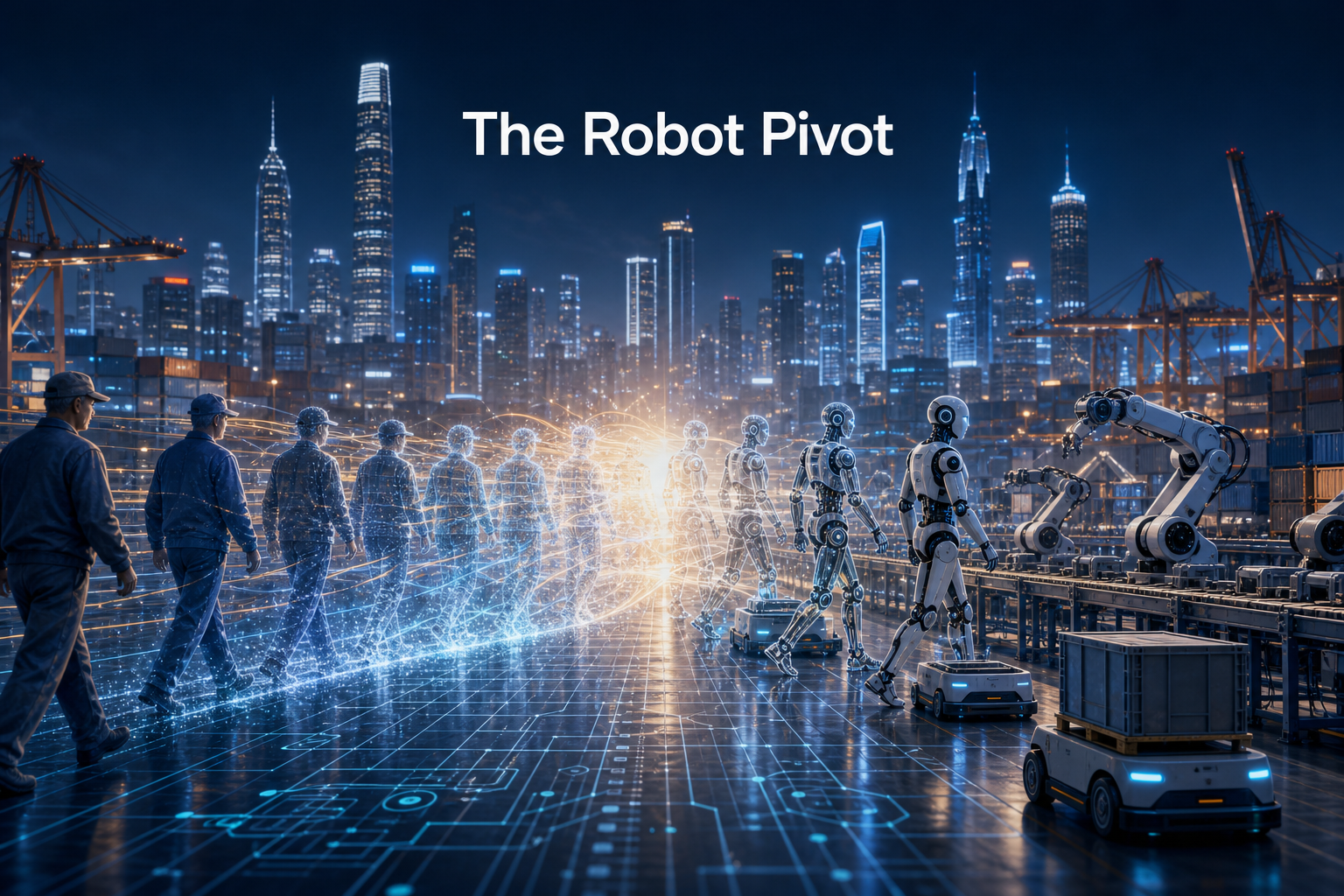
The first part of the robot pivot is already real. Hundreds of thousands of industrial machines are entering Chinese factories each year. The next part is harder. Robots must leave controlled demonstrations, work reliably beside people and earn their cost.
China is placing the wager in public. The machines are being built, the training grounds are opening and the policy capital is flowing. The result will depend on what the robots can do after the demonstration ends.
Market figures are based on the latest releases available on 26 October 2026. Humanoid company counts and deployment estimates vary because research groups use different definitions. This article treats humanoids as one part of the broader automation market and does not constitute an investment recommendation.
Research · Fintech · AI · Infrastructure
A founder-led portfolio of operating and development-stage ventures spanning research, guided change, trade finance, blockchain infrastructure, applied AI, energy and financial intelligence.
Deep-Tech Blockchain Protocol
A deterministic prime-based blockchain architecture built around useful computation, cooperative verification, and post-quantum-oriented infrastructure.
Circular Plastics Infrastructure · Slovakia
A commissioning-stage circular infrastructure project designed to convert difficult plastic-waste streams into recovered industrial products.