MidLincoln Opportunity
Sun in the Morning
redsunam.com · B2B2C Guided Change Platform
A route-based system that helps users navigate concrete personal change while enabling narrow themed deployments for organizations.
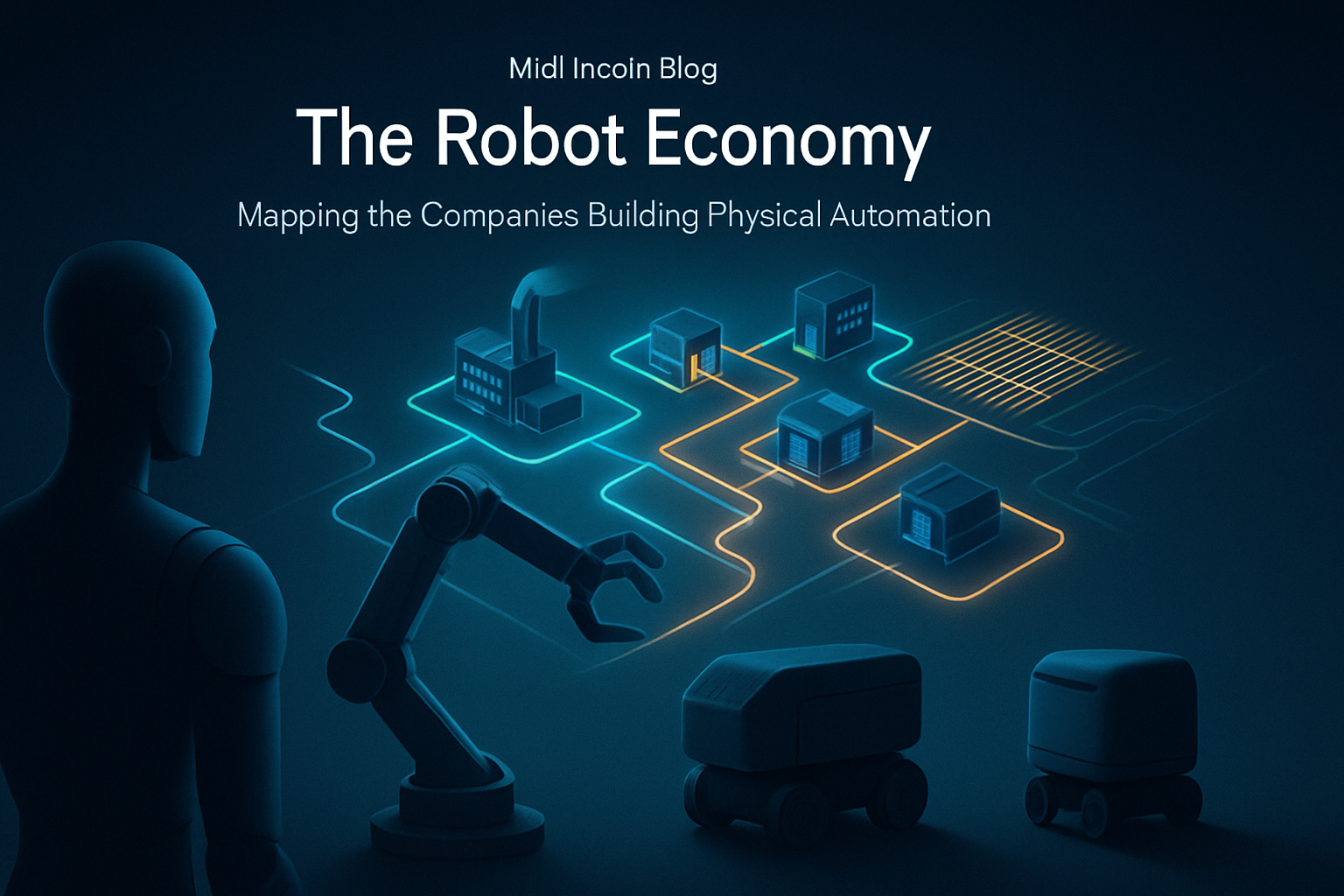
People often picture the robot economy as a humanoid walking through the front door. The real expansion is broader. Robots are moving goods in warehouses, inspecting power stations, assisting surgeons, printing construction layouts, removing weeds, delivering meals and collecting data in places that are expensive or dangerous for people to reach.
The industry now contains several different businesses. Some companies build complete machines. Others build hands, motors, sensors, training data, simulation tools or software for managing fleets. A warehouse robot and a surgical robot share some technology, although their customers, regulation and economics are very different.
This map follows the money and the work. It names the companies attempting to turn physical automation into a business and places them in the part of the stack where they appear strongest.
There is no single total for robotics. Research firms draw the boundary in different places. Some include autonomous vehicles and military drones. Others focus on industrial and service robots. The treatment of diversified groups such as Tesla, Alphabet, Nvidia, ABB and Hyundai changes the answer by hundreds of billions of dollars.
| Measure | Approximate total | What it means |
|---|---|---|
| Robotics companies in the broad IEEE research universe | 17,500+ | Nearly two decades of global company and funding data across seven segments |
| Global robotics venture funding in 2025 | $15bn-$40.7bn | Crunchbase provides the narrower figure; CB Insights uses a wider physical-AI definition |
| US, European and Israeli robotics funding in 2025 | $20.4bn | F-Prime/PitchBook classification covering autonomous vehicles, vertical robots, enabling systems and general-purpose robots |
| Private robotics unicorn value at the end of 2025 | $233bn | F-Prime calculation for companies with disclosed valuations in the US, Europe and Israel |
| Selected public and private robotics equity value | About $0.56tn | MidLincoln calculation from F-Prime's private-unicorn and public-company tables; a useful lower bound rather than a complete global valuation |
The annual flow of investment remains far below $1 trillion. The equity value of a reasonably defined robotics universe has moved beyond half a trillion dollars. Broader totals can exceed $1 trillion after diversified technology and automotive groups are included, though most of their value comes from businesses outside robotics.
Funding estimates also differ because the boundaries differ. Crunchbase counted $15 billion in 2025. CB Insights counted $40.7 billion. F-Prime counted $20.4 billion across the US, Europe and Israel. The range is more honest than a false point estimate.
A robot needs to perceive a scene, understand an instruction, choose an action and recover from mistakes. This has created a new group of companies building general robot intelligence. Physical Intelligence, Skild AI, Generalist, Dyna Robotics, FieldAI and Sunday Robotics are pursuing models that can learn tasks across machines or environments.
The next layer handles robot data and operations. Foxglove and Rerun help engineers inspect complex sensor data. Formant and InOrbit manage deployed fleets. Wandelbots makes industrial robots easier to program. Sereact, Covariant, Nomagic and Mujin concentrate on intelligent manipulation and warehouse work.
Noematrix belongs in this intelligence layer. It combines embodied models, physical data and force feedback. Anyverse Dynamics spans two layers: its MWA world model acts as the brain, while its K15 platform gives the model a body. Both illustrate the growing contest over the software that may control many types of robot.
Humanoids receive the most attention because factories, warehouses and homes were designed around the human body. A machine with two arms, legs or wheels and human-scale reach can use existing doors, shelves, tools and workstations.
The North American and European field includes Figure AI, Agility Robotics, Apptronik, 1X, Sanctuary AI, Boston Dynamics, NEURA Robotics, Mentee Robotics, PAL Robotics, Enchanted Tools and Pollen Robotics.
China and East Asia contain another large group: Unitree Robotics, AGIBOT, UBTECH, Fourier Intelligence, EngineAI, LimX Dynamics, Leju Robot, RobotEra, Galbot, Astribot, XPeng Robotics and Rainbow Robotics.
Agile Robots sits between industrial automation and the general-purpose field. It began with intelligent arms and an operating system and later added a humanoid platform. AGIBOT is a full-stack humanoid company, with its own machines, joints, hands and embodied software. Anyverse Dynamics combines its general robot brain with a mobile dual-arm machine.
Useful work depends on contact. Grasping a soft bag, inserting a connector and lifting a metal casting require different combinations of force, touch and control.
Specialists include Shadow Robot, Tacta Systems, Touchlab, PSYONIC, Tesollo, Robotiq, OnRobot and GelSight. AGILINK, spun out of AGIBOT's hardware operation, focuses on dexterous hands and robotic end effectors.
On the factory floor, Standard Bots, Flexiv, Franka Robotics, Universal Robots, Doosan Robotics, Vention and Formic sell arms, automation systems or capacity as a service. Path Robotics automates welding. GrayMatter Robotics tackles surface finishing. Machina Labs uses robots for flexible metal forming.
Warehouses provide structured space, measurable tasks and customers that understand the cost of every movement. This has made logistics one of the most mature commercial markets.
Mobile and storage systems come from Exotec, Locus Robotics, Geek+, GreyOrange, HAI Robotics, Quicktron, Addverb, Symbotic, AutoStore, Brightpick, Seegrid, OTTO Motors and MiR.
Picking and unloading are being pursued by Dexterity, RightHand Robotics, Ambi Robotics, Plus One Robotics, Nimble, OSARO and Pickle Robot.
Beyond the warehouse, Starship Technologies, Serve Robotics, Coco Robotics and Cartken work on pavement delivery. Nuro and Gatik use road vehicles. Zipline, Wing, Manna and Flytrex take delivery into the air.
Construction sites change every day and contain dust, uneven ground and many independent contractors. The machines therefore tend to automate one clear task. Built Robotics automates heavy equipment and solar piling. Bedrock Robotics works on autonomous earthmoving. Dusty Robotics prints layouts on floors. Canvas finishes drywall. ICON and COBOD print building structures. PaintJet, Civ Robotics, Monumental and AUAR address painting, surveying, masonry and automated building production.
RoboticPlus.AI fits here. It develops construction robots, control software and robotic fabrication for highly customised structures.
On farms, Carbon Robotics, FarmWise, Burro, Naïo Technologies, Ecorobotix, Verdant Robotics, Aigen, Bonsai Robotics, Tortuga AgTech, Tevel, Guardian Agriculture and FarmDroid automate weeding, spraying, harvesting, carrying and field work.
Food preparation has its own specialists: Miso Robotics, Chef Robotics, Hyphen and Picnic Works.
Medical robotics has a longer commercial history and a harder route to market. Regulation, clinical evidence and surgeon training matter as much as mechanical performance.
Intuitive Surgical remains the benchmark. Newer systems come from CMR Surgical, Moon Surgical, Medical Microinstruments, Distalmotion, Noah Medical, PROCEPT BioRobotics, Vicarious Surgical and EndoQuest Robotics.
Mobility and rehabilitation are addressed by Wandercraft, Ekso Bionics and Lifeward. Hospitals use mobile service robots from Diligent Robotics, Relay Robotics and Aethon.
Restaurants, hotels and public buildings provide a wider service market. Bear Robotics, Pudu Robotics and Richtech Robotics sell serving, delivery and cleaning machines. Their progress may say more about near-term adoption than a spectacular humanoid demonstration.
Many strong robot businesses begin where sending a person is costly, slow or dangerous.
ANYbotics sends legged robots through industrial plants. Gecko Robotics inspects critical infrastructure. Flyability builds protected drones for confined spaces. Percepto, Voliro and Exyn Technologies work on autonomous inspection and mapping.
In defence and security, the active field includes Anduril, Shield AI, Skydio, Ghost Robotics, Overland AI, Forterra, Saronic and Saildrone. Nauticus Robotics and Bedrock Ocean Exploration take autonomous systems underwater.
The same logic reaches space through Astrobotic, ispace, Lunar Outpost and GITAI. Remote operation, autonomy and durable machinery connect these companies to the wider robotics stack.
Entertainment is a smaller commercial segment with a different measure of success. The machine must move safely around guests, express personality and remain consistent with a story or character.
Dynamic Creatures is building interactive character robots for entertainment and hospitality. Engineered Arts, Furhat Robotics, Hanson Robotics, AVATARIN and Telexistence explore social presence, remote embodiment and approachable machines.
This category connects robotics with animation, games, live events and location-based attractions. Revenue may come from leasing, ticket sales, branded experiences or remote services. It also offers a public testing ground for human-robot interaction before similar machines enter homes and care settings.
Six companies followed in our research occupy distinct positions in this landscape. Taken together, they form a compact version of the wider physical-automation stack.
| Company | Primary position | Main commercial question |
|---|---|---|
| Agile Robots | Industrial arms, robot operating systems and humanoids | Can one integrated platform serve factories, medicine and general work? |
| RoboticPlus.AI | Construction robotics and fabrication | Can robotic production handle customised building designs economically? |
| AGIBOT | Full humanoid systems | Can manufacturing scale turn technical demonstrations into working fleets? |
| AGILINK | Dexterous hands and joints | Can a component specialist become a standard supplier across robot makers? |
| Noematrix | Embodied models and force-aware robot intelligence | Can its brain generalise across machines and customer environments? |
| Anyverse Dynamics | World models, physical AI and a general-purpose robot | Will value sit in the model, the machine or the closed loop between them? |
The six cover brains, hands, complete bodies and a specialised vertical. This is the same structure visible across the global market.
Robotics produces impressive videos. Investment returns come from machines that work for paying customers.
These measures also explain why specialised robots may create strong businesses sooner than general humanoids. A narrow task gives the buyer a clear comparison between the cost of the machine and the cost of the existing process.
The robot economy will probably feel gradual from street level. Warehouses will add more mobile machines. Farms will automate one crop and one task at a time. Hospitals will add transport and surgical systems. Inspectors will send robots into pipes, tanks, mines and power plants. Entertainment venues will use machines as characters and hosts.
Behind those deployments, a fight over value is taking shape. Complete robot makers want to own hardware, software and fleet data. Model companies want their intelligence to work across many bodies. Component companies want to become standard suppliers. Integrators want to control the relationship with the customer.
The industry already supports thousands of companies and attracts tens of billions of dollars each year. Its tracked equity value can be measured in hundreds of billions. The next stage depends on ordinary operating facts: reliability, useful hours, service cost, manufacturing quality and customer payback.
The robots are arriving through many doors. The most important ones may look too specialised to appear in a science-fiction film.
Market totals draw on the IEEE Robotics & Automation Society global funding report, F-Prime's State of Robotics 2026, Crunchbase robotics funding data, CB Insights' State of Venture 2025 and the International Federation of Robotics. Company descriptions are based on company materials and public announcements reviewed in October 2026.
Private-company valuations, order books and production figures are usually reported by companies or their investors. They should be treated as indications rather than audited market facts. Inclusion in this landscape is descriptive and does not constitute an investment recommendation.
















redsunam.com · B2B2C Guided Change Platform
A route-based system that helps users navigate concrete personal change while enabling narrow themed deployments for organizations.
Deep-Tech Blockchain Protocol
A deterministic prime-based blockchain architecture built around useful computation, cooperative verification, and post-quantum-oriented infrastructure.
tradeflow.ovanex.org · Global Trade Finance Platform
A global invoice financing and trade finance operating platform for SMEs, counterparties, and capital partners.
Mathematical Advisory & Applied AI
Mathematical advisory and applied AI lab designing, auditing and deploying ranking, scoring, forecasting and optimization systems for complex decisions.
Circular Plastics Infrastructure · Slovakia
A commissioning-stage circular infrastructure project designed to convert difficult plastic-waste streams into recovered industrial products.
Research · Fintech · AI · Infrastructure
A founder-led portfolio of operating and development-stage ventures spanning research, guided change, trade finance, blockchain infrastructure, applied AI, energy and financial intelligence.