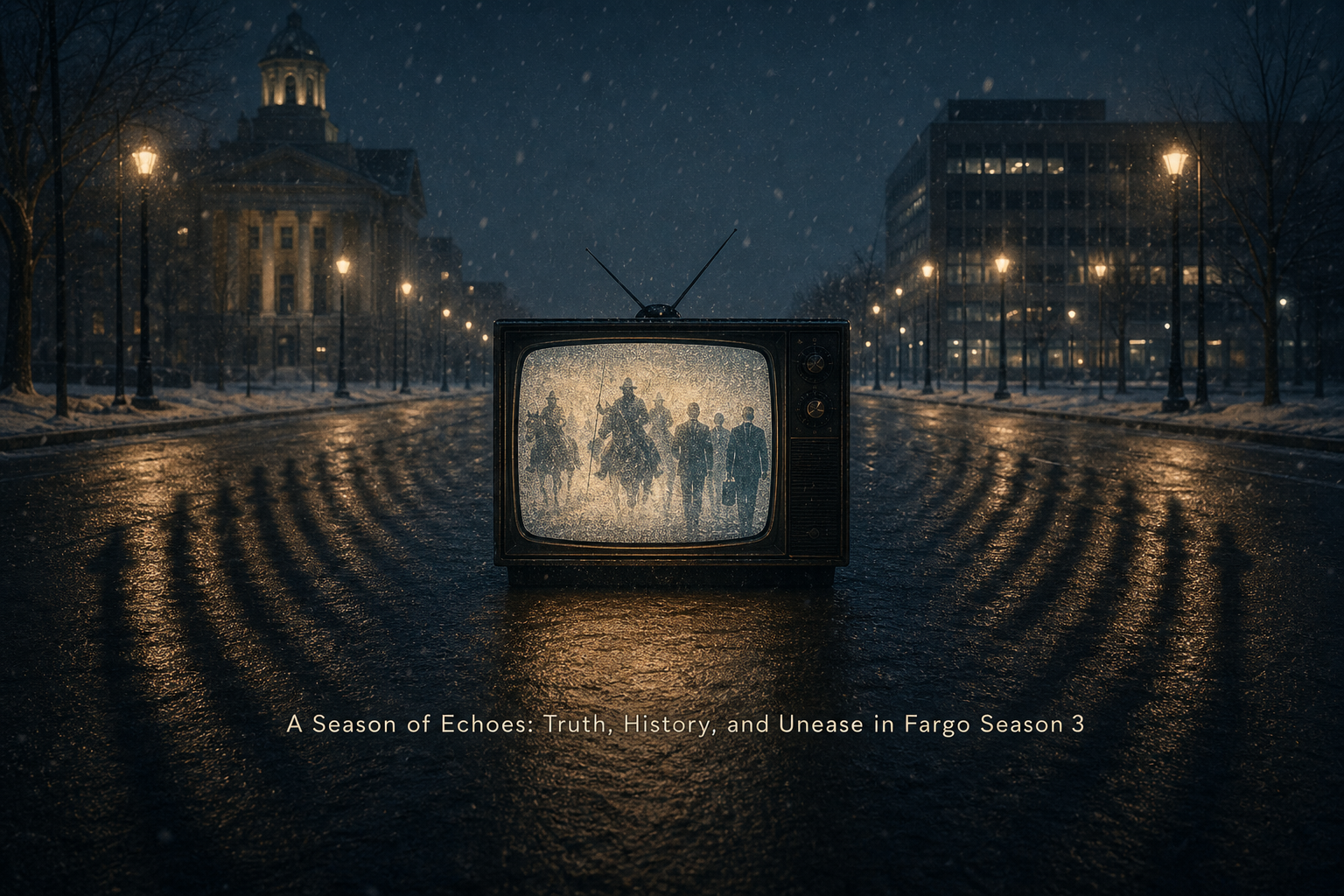
When Fargo Season 3 premiered in 2017, it felt to many viewers like it had arrived from a different era—or perhaps from the near future. Its themes of manipulated truth, fractured reality, and historical reckoning seemed to anticipate a world where facts had become optional. Yet one element of the season has continued to generate unease and debate: its use of Ukrainian and Cossack history, and its resonance with contemporary conflict.
Noah Hawley, the show's creator, has been remarkably consistent in explaining his approach. He has described the season as a "metaphysical" deconstruction of the series' famous opening line: "This is a true story." His goal was to examine how stories replace facts, and how systems of power define reality.
Hawley has traced the Ukrainian/Cossack elements directly to his own family history. His grandmother escaped from Cossacks in what is now Ukraine in the 1890s. This personal connection, he says, is the origin of that storyline—not a reaction to 2014 headlines or a political statement. He has called the timing of the season's release, which coincided with rising Russia-Ukraine tensions, a "coincidence" he "managed to land in."
The most debated scene occurs in Episode 8, at a surreal bowling alley that functions as a supernatural space of judgment. There, the character Yuri Gurka—a Ukrainian immigrant and violent henchman—faces a reckoning. He is confronted by Paul Murrane, a figure tied to Jewish folklore (the Wandering Jew), and the ghosts of his victims, including a woman he murdered years earlier in East Berlin.
Yuri is also identified as a descendant of Cossacks who committed massacres against Jewish communities in Ukraine, notably the Haidamak Massacre of 1768. The scene implies that Yuri is held accountable not just for his own crimes, but for the historical violence of his ancestors.
This has led some viewers to interpret the scene as endorsing a specific ethnic-political message—that the show frames Ukrainians and Jews as historical enemies, and that it dramatizes a form of cosmic justice against Ukrainians.
The creators have consistently rejected this political reading. They emphasize that the scene is part of the show's larger meditation on truth, guilt, and the persistence of history. For Hawley, the Cossack history is a family memory, not a political argument. He has stated that the season's real conflict is not ethnic, but existential: the struggle of an individual (Gloria Burgle) to assert truth against a system (V.M. Varga's post-ideological power) that treats it as irrelevant.
Yet viewers are not obligated to accept the creator's stated intentions. Art can carry meanings its authors did not consciously intend. The imagery—a Ukrainian character meeting a supernatural Jewish figure who pronounces judgment—is potent and open to multiple readings. For some, it resonates with historical trauma and a desire for accountability. For others, it evokes a troubling narrative that maps contemporary conflict onto ancient ethnic divisions.
The ambiguity surrounding the season's meaning is deepened by its central family name: Stussy. The season opens not in Minnesota, but in East Berlin in 1988, in a scene of chilling interrogation by the Stasi, the East German secret police. The thematic link is unmistakable: the Stasi, like V.M. Varga, controls reality by dictating what is true.
For some viewers, the phonetic proximity of "Stussy" to "Stasi" is more than a coincidence. It suggests a grim allegory: perhaps the Stussy brothers, and the corrupt American capitalism they represent, are themselves a product of the Cold War's end. The Stasi's collapse—and the broader Soviet defeat—could be seen as the victory of a system that, like Varga, operates through debt, contracts, and pliable truth. In this reading, the Stussy family's wealth, built on parking lots and legal loopholes, is not just a Minnesota success story, but a haunting legacy of that geopolitical triumph.
This is, admittedly, a speculative thread, one the show never explicitly confirms. Yet the season's very structure invites such "wild fan theories." It offers no single truth, only different facts and competing histories. The lingering question of what the name "Stussy" is meant to evoke is a perfect microcosm of the entire season's design: a puzzle box that forces the audience to decide for themselves what story has been told.
What makes the season so unsettling is precisely this ambiguity. The show refuses to clarify its moral stance definitively. Varga, the season's true villain, represents a form of evil that doesn't need ideology—only systems, debt, and plausible deniability. He is far more dangerous than any ethnic stereotype. But the Cossack/Jewish storyline sits within this larger framework, and its meaning remains unresolved.
For viewers who see the season as a warning about post-truth, the Ukrainian elements serve as a historical echo—a reminder that truth and accountability matter, even when systems try to erase them. For viewers who see it as a political allegory, the season feels like a provocation, or worse.
Fargo Season 3 is a work of art that invites—and resists—interpretation. It draws on personal history, folklore, and existential themes, yet it cannot fully escape the political weight of its imagery. Whether it is a meditation on truth or a more troubling statement is a question each viewer must answer for themselves.
The season's power lies in its refusal to settle this question. It leaves us with the same uncertainty it dramatizes: a world where stories compete, histories echo, and the truth—whatever it is—remains just out of reach.
A route-based system that helps users navigate concrete personal change while enabling narrow themed deployments for organizations.
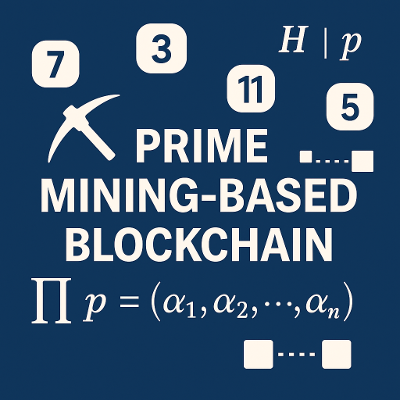
View Opportunity MidLincoln OpportunityA deterministic prime-based blockchain architecture built around useful computation, cooperative verification, and post-quantum-oriented infrastructure.
View Opportunity MidLincoln OpportunityA global invoice financing and trade finance operating platform for SMEs, counterparties, and capital partners.
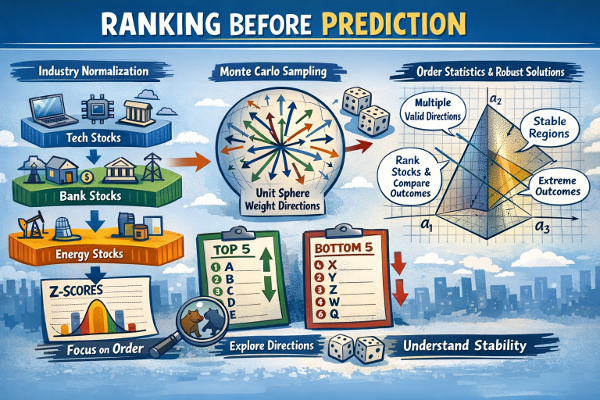
View Opportunity MidLincoln Research & AdvisoryContextual ranking research and advisory for equity selection, sovereign ranking, and model-stability diagnostics under regime uncertainty.
View Offering