For three decades, investors operated under a simple assumption: economics drove markets.
Interest rates, earnings, inflation, and growth determined asset prices. Politics was a sideshow. Geography was irrelevant. Crises were predictable because the underlying models were stable.
That era is over.
The assumptions that defined globalization have broken down. Markets no longer price only economics. They price geopolitics, strategic competition, and structural uncertainty.
The macro winds have changed direction.
This essay examines four forces that are quietly reshaping capital allocation: commodities as strategic assets, the nonlinear nature of crises, politics as an asset class, and the return of geography.
Oil has long been the world's macroeconomic heartbeat.
Lower prices benefit importing economies while pressuring exporters. Higher prices do the reverse. The relationship was simple, predictable, and widely understood.
Today's commodity markets are more complex.
Three forces have fundamentally altered the dynamics:
The result is a market that no longer behaves as it once did. Cheap oil no longer automatically means global prosperity. Expensive oil no longer automatically means recession.
But oil is only the beginning.
Consider what has happened to other commodities:
| Commodity | Why It Matters Now |
|---|---|
| Copper | Electrification requires vast quantities |
| Lithium | Battery production depends on it |
| Rare earths | Semiconductors and defense require them |
| Semiconductors | They are now a strategic commodity |
| Uranium | Nuclear energy is returning |
Each of these has become strategic. Each is now subject to geopolitical constraints that override pure supply and demand. Each represents a market where prices reflect not just economics, but national security concerns.
The shift is structural.
Markets can no longer treat commodities as simple industrial inputs. They are now instruments of strategic competition. The investor who understands this will allocate capital differently from the investor who still believes that supply and demand determine everything.
Crises rarely arrive unexpectedly.
They usually begin with small imbalances that accumulate over time: excessive leverage, declining productivity, expensive asset valuations, political polarization, deteriorating fiscal positions. Markets tend to ignore these signals until confidence suddenly disappears.
History suggests that crises are usually visible long before they become obvious.
So why do they keep surprising investors?
Because investors extrapolate linear trends.
Consider the historical pattern:
| Crisis | Years | What Investors Missed |
|---|---|---|
| 2008 | 3-5 years | Housing bubble, subprime, leverage |
| 2000 | 2-3 years | Tech valuations, IPO mania |
| 1990 | 4-5 years | Real estate, banking excess |
| 1987 | 1-2 years | Portfolio insurance, program trading |
In every case, the signs were there. In every case, markets assumed the trend would continue. In every case, the crisis arrived as a nonlinear shock—a sudden collapse that seemed to come from nowhere but had been building for years.
The warning signs are visible today:
None of these alone would cause a crisis. Together, they create vulnerability.
The question is not whether a crisis will occur, but what will trigger it. A geopolitical shock. A policy mistake. A financial accident. Some unexpected event that breaks confidence.
The investor who prepares for nonlinear outcomes will outperform the investor who assumes the future will resemble the past.
Every American election now influences global markets.
The United States exports not only goods and capital, but policy. Changes in taxation, trade, defense, technology regulation, and energy in Washington ripple across every financial center.
This creates a unique form of political risk for global investors:
Markets react not simply to election winners, but to expectations of future policy. The signal is as important as the outcome.
Why does this matter now more than ever?
Three reasons.
First, the policy gap between the two American political parties has widened significantly. The outcome of any given election now produces larger policy swings than it did a generation ago.
Second, the global economy is more interconnected than ever. Policy changes in Washington affect supply chains in Asia, commodity prices in Latin America, and capital flows in Europe.
Third, the rest of the world has fewer alternatives. China's capital markets are not yet fully open. Europe's are fragmented. India's are growing but still small. The United States remains the largest, deepest, most liquid capital market in the world.
Politics has become investable.
Consider the sectors most affected:
The investor who ignores politics does so at their own risk.
For twenty years, economists believed geography mattered less.
The internet connected everyone. Containers moved goods cheaply. Globalization integrated supply chains. Location seemed to matter less than connectivity.
That era is over.
Geography is back. Pipelines matter. Ports matter. Straits matter. Shipping routes matter. Critical minerals matter. Proximity to markets matters.
Consider what has changed:
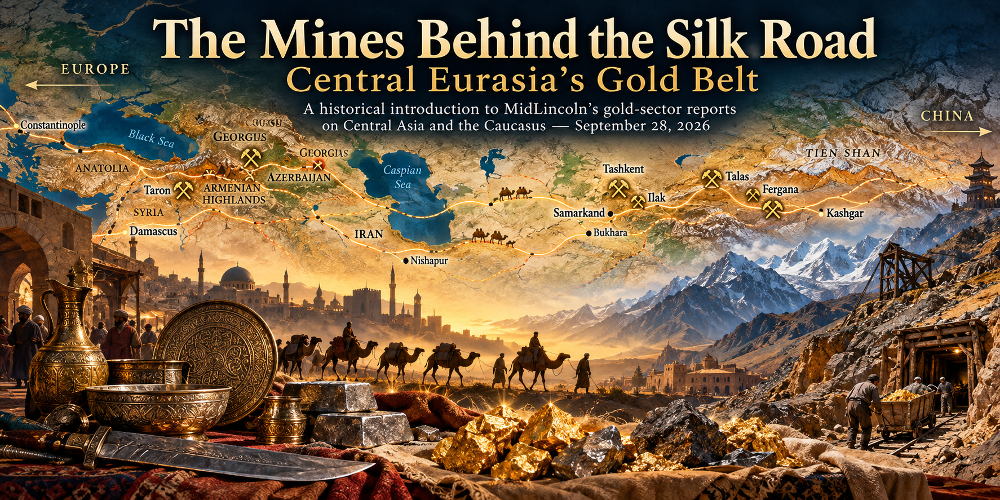
The geopolitical center of gravity is gradually moving toward Eurasia.
Trade routes, energy corridors, semiconductor supply chains, critical minerals, and infrastructure investments increasingly intersect across one enormous continent. The competition is not military, but strategic: who controls the flows of goods, energy, and data?
What should investors watch?
Three corridors.
First, the Middle Corridor—the trade route connecting China to Europe through Central Asia and the Caucasus. This bypasses Russia and offers an alternative to maritime shipping.
Second, the South China Sea—where maritime trade routes meet military competition.
Third, the Arctic—where melting ice opens new shipping lanes and access to resources.
These are not headlines. They are structural shifts in the geography of global commerce. Investors who understand the new map will outperform those who don't.
One force deserves its own section.
Central banks are no longer simply monetary authorities. They are strategic actors.
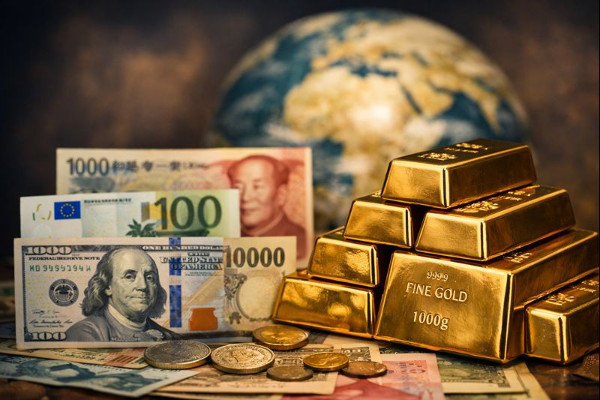
The investors who understand that money itself has become strategic will see opportunities that others miss. The investors who still assume the dollar will remain the world's only reserve currency are operating on assumptions that are gradually becoming obsolete.
Let us summarize the structural shifts:
| Force | Old Assumption | New Reality |
|---|---|---|
| Commodities | Priced by supply and demand | Strategic assets |
| Crises | Predictable from models | Nonlinear shocks |
| Politics | Sideshow to economics | An asset class |
| Geography | Less relevant | Returned |
| Money | Stable system | Strategic competition |
The diagram tells the story:
| 1990-2020 | 2025+ |
|---|---|
| Economics → Markets | Politics → Economics → Markets |
Every investment cycle teaches a different lesson.
The lesson of the coming decade may be that politics, geography, and money matter as much as interest rates and earnings. Investors who continue viewing markets through purely financial models may find that the rules have quietly changed.
Markets don't collapse because of one event.
They weaken because dozens of small structural changes begin pointing in the same direction.
Oil no longer gives a reliable signal.
Crises are nonlinear.
Politics has become investable.
Geography has returned.
Money is now strategic.
The macro winds have changed.
The only question is whether investors are paying attention.
— MidLincoln View
This essay is the second in a four-part series on the forces reshaping global capital allocation. The first essay examined five competing models of capitalism. The third essay will explore the economics of wellbeing. The fourth will examine the privatization of infrastructure.
A route-based system that helps users navigate concrete personal change while enabling narrow themed deployments for organizations.
View Opportunity MidLincoln OpportunityA deterministic prime-based blockchain architecture built around useful computation, cooperative verification, and post-quantum-oriented infrastructure.
View Opportunity MidLincoln OpportunityA global invoice financing and trade finance operating platform for SMEs, counterparties, and capital partners.
View Opportunity MidLincoln Research & AdvisoryContextual ranking research and advisory for equity selection, sovereign ranking, and model-stability diagnostics under regime uncertainty.
View Offering