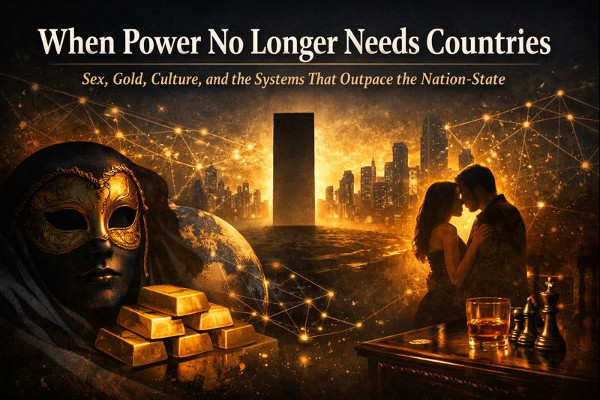
When Power No Longer Needs Countries

Sex, Gold, Culture, and the Systems That Outpace the Nation-State — February 2, 2026

Introduction
Countries rarely fall through invasion or ideology alone. They erode when the forces that motivate human behavior detach from the structures meant to govern them. Intellect enables abstraction, allowing humans to imagine systems larger than themselves; sex remains a primal driver of status, risk, and ambition; gold stabilizes desire by converting it into durable value; power coordinates access and shields accumulation; and space — whether as frontier or image — sustains the belief that progress continues. When these variables align within a state, authority feels legitimate. When they decouple, the state persists in form but weakens in function.
In the current phase of disglobalisation, these drivers increasingly operate outside national frameworks. Desire is global, value is mobile, power is networked, intellect is individualized, and aspiration is projected through symbols rather than collective achievement. Governments still legislate, but they no longer mediate meaning. They manage narratives while incentives flow elsewhere. The result is not immediate collapse, but a gradual hollowing: countries remain, yet the behaviors that once sustained them no longer depend on national context.
What follows is not chaos, but drift. As sex, gold, power, intellect, and aspiration find expression beyond borders, the nation-state becomes a stage rather than an engine. Systems continue to function, markets continue to price reality, and individuals adapt. Falling countries are not overthrown; they are quietly outpaced. The question is no longer whether states will survive, but whether they can realign human incentives faster than those incentives reorganize themselves.
It is against this backdrop that popular culture becomes unexpectedly revealing. Even works as unlikely as Morning Glory Milking Farm can be mobilized in electoral politics — sometimes humorously, sometimes provocatively — as shorthand for how economic pressure and gendered expectations shape individual choices in a disglobalising world. The resonance of such a premise is not a curiosity of taste, but a signal of stress: student debt, precarious labor, and the monetization of intimacy have become familiar enough that satire no longer feels distant from reality.
Read this way, the book functions less as fiction than as cultural symptom. It reflects a moment in which traditional institutions fail to provide security or meaning, leaving individuals to negotiate value, dignity, and survival on their own terms. That this negotiation is framed through sex, labor, and exchange is not incidental. These are among the oldest human variables, re-emerging as stabilizers when formal structures weaken.
What matters here is not the work itself, but what its circulation suggests. Political language no longer originates solely in policy or ideology, but increasingly in fragmented cultural artifacts that capture lived experience more directly than official narratives. This shift mirrors the broader condition of disglobalisation: states retain form, but culture absorbs the task of explaining how power, value, and agency are actually experienced.
Kubrick as an early diagnostician of post-national power
Long before disglobalisation became a measurable trend, Stanley Kubrick explored what happens when the structures governing human behavior lose their binding force. His films are not predictions, nor allegories with fixed meanings. They are stress tests: controlled environments in which systems are pushed just far enough to reveal how authority decays, how meaning thins, and how power persists without justification.
In Dr. Strangelove or: How I Learned to Stop Worrying and Love the Bomb, the nation-state still appears intact, yet control has already slipped into automated logic and procedural habit. Leaders speak, rituals are observed, but outcomes are determined elsewhere. The Soviet ambassador calmly ordering a drink as catastrophe unfolds is not a caricature of ideology, but a portrait of bureaucratic alienation: individuals trapped inside systems that function independently of intention or morality. The state exists, but agency has dissolved into process.
By the time of 2001: A Space Odyssey, ideology recedes into background noise, rendered irrelevant by forces that exceed human comprehension. Intelligence advances, but wisdom does not keep pace. The monolith — imagined here as a vast, inert mass — (possibly gold) functions as a catalyst rather than a teacher, revealing latent capacities without providing guidance. What matters is not who governs, but what motivates. Human progress accelerates, yet ethical alignment remains absent — a condition increasingly familiar in systems driven by capital, technology, and abstraction rather than collective purpose.
In The Shining, spatial impossibilities, repeating patterns, and Apollo imagery point not to hidden confessions, but to image-mediated reality. Kubrick understood that modern belief is shaped less by experience than by visual authority. Space programs, like institutions, are continually reinvented through imagery — whether or not substance keeps pace.
This trajectory reaches its most unsettling articulation in Eyes Wide Shut, released at the close of the 1990s, a period already marked by visible strain in the relationship between power, morality, and public legitimacy. In retrospect, the film’s themes resonate strongly with contemporaneous and subsequent events — from the Clinton–Lewinsky scandal, which exposed the fragility of moral authority at the highest levels of state power, to the later revelations surrounding Epstein, which intensified global concern about elite impunity beyond national jurisdictions. These episodes did not cause geopolitical shifts on their own, but they coincided with a moment when Western institutions were increasingly forced to manage legitimacy at the same time as NATO interventions expanded and strategic anxieties in the Middle East, including around Iran, began to harden.
In Eyes Wide Shut, power has fully detached from national identity. Accents replace flags; access replaces office. The elite world Kubrick depicts does not conspire against the state — it simply no longer requires it. Ritual, discretion, and insulation are sufficient. Citizenship becomes incidental. Countries still exist, but power no longer depends on them.
Across these films, Kubrick returns to the same underlying condition: systems mature faster than ethics, and once they do, legitimacy becomes optional. Authority persists through habit, symbolism, and controlled visibility, while the forces that shape outcomes operate transnationally and often invisibly. Kubrick does not argue that this is engineered; he shows that it is structural.
Disglobalisation as lived reality
Around 2014, disglobalisation begins not with collapse, but with friction: Crimea, sanctions, trade weaponization. Capital begins to recognize that borders are no longer neutral. Globalisation shifts from efficiency to resilience. The system turns inward, even as rhetoric remains global.
Disglobalisation does not mean isolation; it means fragmentation. Supply chains regionalize. Power diffuses. Institutions remain visible, but decision-making migrates elsewhere. States still speak loudly — but increasingly decide less.
The second phase follows quietly. Governments lose grip without admitting it. Markets, capital flows, data, and logistics outrun regulation. Political responses become symbolic: laws, speeches, summits. Real control migrates into financial plumbing, platforms, and private coordination. Authority becomes performative.
Epstein emerges here not as scandal, but as symptom. The case does not reveal a hidden order; it exposes something more unsettling — moral enforcement fails at scale. Legality, reputation, and accountability diverge. This signals systemic moral erosion, not individual pathology. And that erosion is global.
Gold, in this context, functions as catalyst rather than conspiracy. It has no utility proportional to its power. It survives regimes, ideologies, and borders. Rising gold prices do not signal apocalypse; they signal rational retreat from abstractions. Whether gold amplifies “evil” or “rationality” depends entirely on the system it enters.
Markets already behave as if states matter less. Capital prices risk faster than policy reacts. Currencies weaken without political collapse. Assets decouple from national narratives. Markets are voting — quietly — on where authority actually resides.
Conclusion: falling countries
Countries do not disappear when borders are crossed or ideologies collapse. They weaken when the forces that organize human behavior slip beyond their reach. Intellect abstracts faster than institutions adapt. Desire continues to drive status, risk, and ambition regardless of moral frameworks. Value seeks permanence when trust in abstractions erodes. Power reorganizes itself around access rather than legitimacy. And the idea of progress survives through symbols — frontiers, technologies, images — even as collective direction fragments.
In this phase of disglobalisation, these forces no longer align naturally within national structures. Desire is global, value is mobile, power is networked, intellect is individualized, and aspiration is increasingly symbolic. Governments still legislate, but they no longer anchor meaning. They manage narratives while incentives flow elsewhere. What emerges is not collapse, but thinning — authority remains visible, yet its capacity to coordinate behavior steadily diminishes.
This is why falling countries rarely announce their decline. There is no singular rupture, no decisive defeat. Instead, systems continue to function, markets continue to price reality, and individuals adapt rationally to the incentives before them. States persist as form, but their role as engines of coordination weakens. Power does not overthrow them; it simply moves on.
The question, then, is not whether countries will survive. Many will. The question is whether they can realign human incentives — desire, value, abstraction, authority, and aspiration — faster than those incentives continue to reorganize themselves beyond borders. History suggests that when systems fail to do so, they are not destroyed. They are quietly outpaced.

< Advertisement banner top